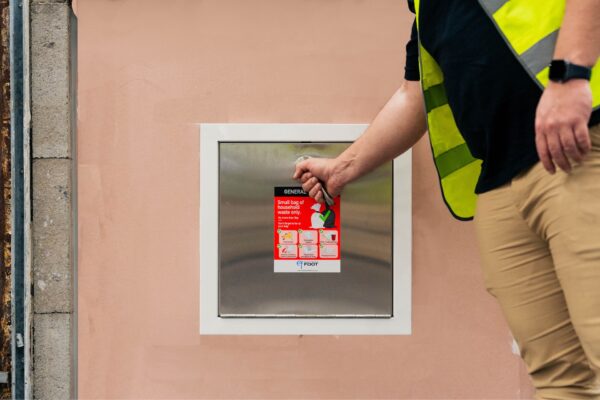
Our technicians inspect every chute door on the affected floors, checking self-closing and latching performance (per AS 1851), seal integrity, hinge condition and fire-rating labels. You receive a written condition report with photos.

A damaged or non-compliant chute door is a fire safety liability. From hopper door repairs and garbage chute door replacement to sourcing genuine chute door parts, Elephants Foot Service & Care delivers complete chute door maintenance across NSW, VIC and QLD, backed by Elephants Foot Group's 50 years of chute system engineering and full compliance documentation.
A chute door that doesn’t self-close and latch properly under AS 1851 testing isn’t just a chute door maintenance issue. It’s a smoke and fire door compliance failure that puts your annual certification at risk. When a non-fire-rated or incorrectly installed door gets flagged during an AFSS inspection, the remediation path, whether hopper door repairs or full garbage chute door replacement, often costs more than getting it right the first time.


Annual compliance inspections for fire-rated chute doors, covering self-closing performance, seal condition and AS 1851 documentation for your AFSS or ESM register.

Full chute system repairs including shaft lining, decommissioning of failed sections and structural restoration for ageing or damaged garbage chute infrastructure.

Scheduled chute door maintenance programs that keep hopper doors, chute shafts and waste rooms operating safely and compliantly, reducing emergency call-outs and extending chute door part lifespan.
Contact
Whether you need a single hopper door repair, a full garbage chute door replacement across every floor, or a strata building chute door repair service covering annual compliance, the Elephants Foot Service & Care team will assess the condition of your chute doors, provide a written report and quote for all chute door maintenance work required.
A chute door typically needs repair when individual chute door parts have failed but the frame and fire-rating remain intact. Common hopper door repair scenarios include broken or seized self-closing chute door hinges, deteriorated intumescent chute door seals, failed latch mechanisms, or a fusible link that has activated. These chute door parts can be replaced individually without removing the entire door assembly.
Full garbage chute door replacement is necessary when the door frame is warped or corroded beyond adjustment, when the fire-rating label is missing or illegible and the door’s provenance cannot be verified, or when a non-fire-rated commercial door was installed in error. If the door cannot demonstrate self-closing and latching performance under AS 1851 testing after component-level hopper door repairs, replacement is the correct path. Our technicians make this assessment on-site during the initial inspection and provide a written recommendation with costed options for both chute door repair and full replacement. Buildings in Sydney can also request a fire-rated chute door replacement as part of a broader chute system overhaul.
Yes. Under the National Construction Code (NCC 2022), specifically provision C4D14, garbage chutes in multi-storey strata buildings must be fire-compartmented. The intake doors (hopper doors on each floor) form part of that fire compartmentation and are required to be fire-rated to prevent fire and smoke from travelling between floors through the chute shaft. This is why garbage chute door replacement with genuine fire-rated chute doors is essential when existing doors fail.
Each state enforces this through its own compliance framework. In NSW, chute doors fall under the Annual Fire Safety Statement (AFSS) regime. In Victoria, they are covered by Essential Safety Measures. Queensland has equivalent building fire safety requirements. The doors must be genuine fire-rated door sets, tested to AS 1530.4-2014 and procured to AS/NZS 1905.1. A standard commercial door, even if it looks similar, does not meet the specification and will be failed during an inspection. Where fire detection systems are present (per AS 1670), doors may also need to integrate with automatic closure and release mechanisms.
Fire-rated chute doors in Australia are tested to AS 1530.4-2014 (Methods for fire tests on building materials, components and structures: Fire-resistance tests for elements of construction). This standard determines the door’s Fire Resistance Level (FRL). Elephants Foot doors are rated FRL -/120/30, meaning they provide 120 minutes of integrity and 30 minutes of insulation against fire spread.
Inspection frequency is governed by AS 1851 (Routine service of fire protection systems and equipment). Chute doors, as fire-rated components of the building’s compartmentation system, must be inspected annually at a minimum. The inspection checks self-closing performance, latching function, chute door seal condition and fire-rating labelling. Proactive chute door maintenance between inspections, including replacing worn chute door hinges and seals, reduces the risk of failure during the annual test. Results must be documented and submitted as part of the building’s fire safety compliance statement. For a detailed walkthrough of what to expect, see our guide to chute fire safety inspections in Australia.